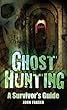
The author is vice-chair (investigations) of The Ghost Club (that faction of the old Ghost Club which allows non-toffs to join) and a member of the Spontaneous Cases Committee of the Society for Psychical Research. His book on ghost hunting does not go into the detailed minutiae of equipment that A Beginner's Guide to Paranormal Investigation reviewed by John Rimmer does, but perhaps provides a broader overview.
He looks at the various groups involved, concentrating on the Ghost Club, Society for Psychical Research and ASSAP, pointing out the strengths and weaknesses of each, and provides much practical advice for ghost hunters, including the types of location to choose and avoid, and times of the year to watch out for. Particularly ghost hunters should avoid half-built follies in the middle of winter, and just about any urban location in the firework season. He also gives much sensible advice on making sure that your teams are small enough to be handled.
Fraser also critically examines the various types of equipment used, and rather suggests that some of these seem to be taken mainly because they look impressively scientific, rather than for their practical use. Much more controversially he seems to be in favour of taking 'psychics' and 'mediums' along. This surely is assuming the answers before asking the questions, and apart from a nod toward the infrasound theories of Vic Tandy there is little attempt to get beyond such folkloric 'explanations' of ghosts such as spirits or the 'stone tape' theory. If it is entertaining stories that will add to the atmosphere, it might be better to hire a local folklorist or story teller, they are likely to be far more professional in their actions, and far less heavy duty.
Of course, looking through the various locales mentioned here, it seems that the main aim of this sort of ghost hunting is having a rather spooky time in 'ye olde haunted spot', reinforcing the folkloric image of ghosts being associated with decaying mansions and country houses, rather than with cinemas, shopping centres, car factories and quite modern private homes. Of course, as Fraser points out, there are a number of practical problems with many of these, as well as ethical problems with the latter.
While this sort of ghost hunting may be good fun for those who take part, Fraser has to concede that they are not at all likely to provide evidence to convince sceptical outsiders that something anomalous is going on, still less what exactly these anomalies might be. -- Reviewed by Peter Rogerson
He looks at the various groups involved, concentrating on the Ghost Club, Society for Psychical Research and ASSAP, pointing out the strengths and weaknesses of each, and provides much practical advice for ghost hunters, including the types of location to choose and avoid, and times of the year to watch out for. Particularly ghost hunters should avoid half-built follies in the middle of winter, and just about any urban location in the firework season. He also gives much sensible advice on making sure that your teams are small enough to be handled.
Fraser also critically examines the various types of equipment used, and rather suggests that some of these seem to be taken mainly because they look impressively scientific, rather than for their practical use. Much more controversially he seems to be in favour of taking 'psychics' and 'mediums' along. This surely is assuming the answers before asking the questions, and apart from a nod toward the infrasound theories of Vic Tandy there is little attempt to get beyond such folkloric 'explanations' of ghosts such as spirits or the 'stone tape' theory. If it is entertaining stories that will add to the atmosphere, it might be better to hire a local folklorist or story teller, they are likely to be far more professional in their actions, and far less heavy duty.
Of course, looking through the various locales mentioned here, it seems that the main aim of this sort of ghost hunting is having a rather spooky time in 'ye olde haunted spot', reinforcing the folkloric image of ghosts being associated with decaying mansions and country houses, rather than with cinemas, shopping centres, car factories and quite modern private homes. Of course, as Fraser points out, there are a number of practical problems with many of these, as well as ethical problems with the latter.
While this sort of ghost hunting may be good fun for those who take part, Fraser has to concede that they are not at all likely to provide evidence to convince sceptical outsiders that something anomalous is going on, still less what exactly these anomalies might be. -- Reviewed by Peter Rogerson