30.1.11

SLEIGHTS OF MIND

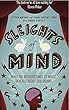
Stephen Macknik and Susana Martinez-Conde, with Sandra Blakeslee. Sleights of Mind: What the Neuroscience of Magic Reveals About Our Brains. Profile Books, 2011

A word of warning, if you love the wonder of magic shows and do not want on any account to know how magic tricks (even, one suspects, old and superseded ones) work, then do not read this book. If on the other hand you want to know what magic tricks can tell us about how we perceive the world, and what they illustrated about the human perceptual processes, then this book is for you.

The husband and wife team who wrote this book are neurologists at the Barrow Institute in Phoenix, Arizona who have been working with some of the USA and Spain's leading magicians and mentalists to work out how they, sometimes unconsciously, sometimes consciously, use the gaps and short cuts in human perception, and illusions of perception, cognition and memory, to work their magic, and have persuaded several to reveal at least some of their secrets.

Though the authors' brief encounters with "psychics" at Sedonia, reveal that most of these are very poor at practices like cold reading, many of the insights in this book are invaluable for anyone investigating paranormal claims and in evaluating how much of what is presented in the literature is likely to have happened exactly as described therein.

This does not necessarily mean that someone with the skill of a professional magician is involved in these accounts; nature can play the magician on occasion, and often does. It should be noted that when tricks are involved they are not going to require anything like the skill employed by the magicians whose work is profiled here. These guys (and it mainly is guys still) have to perform to order night after night in front of often sophisticated audiences on the look out for how the trick is done. If they make a mistake and accidentally reveal how a trick is done, they can be effectively blackballed out of the profession and lose their careers. No excuses about the vibrations not being right or their being a sceptic in the audience for them.

The authors make it clear that what the magicians exploit should not be thought of as 'errors' in perception, they are part of the natural perceptual processes which has evolved to best and most economically allow our ancestors to survive in the wild. -- Reviewed by Peter Rogerson

27.1.11

RAPS, TAPS AND REBRANDING UFOLOGY

Having now joined the two Johns [Harney and Rimmer] in the great ranks of the retired, I hope to have more time to devote to Northern Echoes, and perhaps even an article or two.

My review of Robert McLuhan's Randi's Prize has brought a response from the author on his website, which sadly descended to the now usual SPR-type argument from snobbery, i.e. that it is quite impossible for 'those sort of people', (in this case problem children) to fool their betters. People who think like that are setting themselves up for a fall.
More interestingly McLuhan reminds us of the origins of Spiritualism in the tale of the Fox sisters. I might well come back to this story in more detail later one, but for the meantime there are some interesting sidelights rarely commented on. The story starts with two girls, Margaritta (about 14 going on 15) and Catharina (about 12 going on 13) Fox living with their ageing parents (58 and 50) in a small property in the hamlet of Hydesville New York. Though one cannot be certain of the fact, it is probable that the place had acquired the reputation of being haunted, at least in the minds of local teenagers. Some time toward the end of March 1848 the family started to hear things that went bump in the night.

"On Friday night" (presumably the 24th) the girls start to play a game with the noises, calling out "Here Mr Splitfoot" and the raps seem to answer questions, or so the memory goes.

Of course to really understand what is going on here, we would have to possess much more knowledge about this property, just who was in it, what the sleeping arrangements were, where the neighbours were. In fact using a vast range of historical documents a historian would virtually have to simulate Hydesville in a computer. Maybe some New York based historian will one day do just that.

Mr Splitfoot turned out to be a ghost, and Mr Splitfoot actually was quite an apposite name, for Mr S had one foot in the past and another in the future. On the one hand he was a traditional ghost, not your SPR approved drifting wraith, but a traditional ghost with a purpose, such as leading you to hidden treasure, warning of the fearful fate of your soul if you did not mend your sinful ways, or, as in this case, outing murder. On the other hand this was a ghost which looked to the future, to the world of the new sciences, the telegraph, above all the world of show business fame and celebrity culture.

This would, at least first rescue the two young Fox sisters from the life fate had mapped out for them as tail-end daughters. Many teenagers complain about being bored, but I suspect compared with lives of these two girls and many like them few modern western teenagers know what boredom is. A young woman's lament from this period complained their lives were "always controlled, always confined, controlled by your parents until you're a wife, controlled by your husband the rest of your life". Tail-end daughters would be lucky to get the husband, because often they were the ones who had to stay at home and look after their aged parents.

Instead the Fox girls pioneer mediumship as a way that working class girls can gain celebrity without lying on their backs all the time. Their lives would prefigure the lives of modern celebrities to a remarkable degree, the exploitative, manipulative manager (their eldest sister), the celebrity romances (Margaret gets involved with an arctic explorer) which go publicly wrong, the celebrity addictions, the celebrity rehab, the celebrity custody disputes, the celebrity confessions and retractions, the renunciation of the celebrity lifestyle and then the return, the general total car crash lives.

Right from the beginning Mr Splitfoot brings excitement to their dull lives. We may never know whether the girls were themselves responsible for all the bumps and bangs which set the thing off, or whether they jumped on the bandwagon, it gave them a good time. From their behaviour it is difficult not to conclude that even if the girls didn't make all the noises themselves, they knew who or what did.
Jim Schnabel's Heretical Notions blog contains some ideas on re-branding ufology.
He's got it pretty wrong of course, talking about exotechnology, because that just links into the ETH, which presumes an answer before asking the questions, and has no chance. 'The Institute for the Study of Uncatalogued Atmospheric Phenomena' might just get somewhere. Please compare and contrast his suggestions with some of the ones made by yours truly as a naive teenager nearly 40 years ago: New Directions for UFO Research
Round and round in circles we go.

26.1.11

SIGNS AND WONDERS

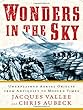
Jacques Vallee and Chris Aubeck. Wonders in the Sky: Unexplained Aerial Objects from Antiquity to Modern Times, and Their Impact on Human Culture, History and Belief. Tarcher/Penguin, 2010. -- Reviewed by Peter Rogerson.

From its earliest days ufology sought to create a history for itself. To some extent one already existed in the books of Charles Fort, and stories from Fort were used by early writers such as Donald Keyhoe to bolster that history. Other writers such as Desmond Leslie, Harold Tom Wilkins, Morris K. Jessup Jnr, delved much further into the ancient chronicles of Greece and Roman and medieval accounts of prodigies, as well as the works of three centuries of astronomers and naturalists to generate long lists of old events which could somehow be interpreted as UFOs. By the late 1960s these were joined by the pioneers of the Ancient Astronaut school of writing, led in Britain by the pioneer of ufological camp, Raymond Drake. Others looked back to historical events such as the great airship waves of 1897 or 1908, or the strange lights associated with the Welsh revival of 1905. Indeed it was a common interest in these old stories which led to MUFOB's association with our absent friend Roger Sandell.

Jacques Vallee, like John Michell before him, associated UFO stories with traditional fairy lore in his hugely influential Passport to Magonia, from which we obtained our title. Both Vallee and Michell were gifted writers and both appealed to the hippie romanticism of the late 1960s and early 1970s. Even before Passport to Magonia appeared John Rimmer pointed out the similarities to modern UFO lore in the Irish fairy stories of D. A. MacManus.

John's review of Passport to Magonia was linked to that of another book on Irish fairy and folklore Lady Gregory's Visions and Beliefs in the West of Ireland.

As John's new introduction to that review shows, times changed. In particular the critical studies of the 1897 airship reports by the likes of Jerome Clark and Eddie Bullard and those of the 1909 and 1913 British airship waves by Nigel Watson and David Clarke, showed these stories cannot be wrenched from their historical and cultural context, or regarded uncritically as 'genuine anomalies'. Many of the more dramatic airship stories were probably newspaper hoaxes, the products of creative writing competitions or even possibly in some cases of black propaganda. The less dramatic stories like most modern UFO reports were probably the product of misidentification and misperception of a variety of common astronomical and meteorological phenomena.

This led to a reaction in which the 'UFO phenomenon' was seen as an essentially modern experience, with little prior history.

Jacques Vallee and Chris Aubeck here aim to restore that lost history. Following the route laid out by Wilkins and Drake they assemble all sorts of narratives and fragments from the ancient world up to 1879.

With an introduction by David Hufford, it is divided into three sections. 'A Chronology of Wonders' contains reports which the authors claim resist their attempts at conventional explanation, and have at least a precise date and place. A second section entitled 'Myths Legends and Chariots of the Gods' includes vaguer reports; those which might have a conventional explanation are listed as well as modern hoaxes, and finally a section dealing with sources and methods,

The main catalogue is an incredibly diverse collection, including portents in the sky, an alleged satellite of Venus, anomalous meteorites, the miracles associated with saints, visions of the Virgin Mary, accounts of transvection produced by people accused of witchcraft when under torture, the levitation of the religious, the famous Drummer of Tedworth, and just about everything bar Uncle Tom Cobleigh and his phantom grey mare.

At one level this might be acceptable. We could see this as a collection of accounts, any one of which today might just about be classed as a UFO story and get into some UFO book or other. We could see it as a way of showing that human beings have attributed all sorts of meanings to a variety of strange phenomena, events and experiences. What we cannot do, is what the authors (or at least Vallée) seem to want to do, which is to present all these stories as being 'genuine' accounts of some totally anomalous unitary UFO phenomenon. The raw reading of the stories clearly indicates that they refer to many different phenomena and experiences, just as do modern reports. It also must be said that the connections between the two in some cases seem fairly strained.

It is damned difficult to work out exactly what was experienced and what caused the experiences when dealing with accounts reported a week ago. Sceptically minded ufologists know how extraordinarily difficult it can be to rule out 'normal' phenomena in modern cases, and how dramatic stories can be generated by sightings of Venus or even the Moon. How much more difficult to do this with fragmentary tales in ancient chronicles.

It requires a great stretch of the imagination for modern city dwellers, to try and recapture this ancient world: a world before street lighting, when nights were of Stygian darkness and the sky filled with stars and nebulae. Phenomena barely visible to us would have been much more vivid. It is perhaps not surprising that a greater number of rare natural phenomena were then reported. But as historians have argued, this world was also one in which the imagination projected more things against this backdrop, a world where malnutrition, stress, toxins in food, disease and so forth led to altered states of consciousness.

If today stars, planets and meteorites can become magical machines, then in the past they could be armies in the sky, men worshipping at altars, spears and shields, armies in the sky, or flying dragons and the like.

Of course these accounts are not without interest, and the portions relating to strange lights in the sky may well contain material of interest to astronomers and meteorologists. This is particularly true of the material from the nineteenth century. For example some of the observations of dark objects crossing the sun might be early accounts of near-earth asteroids.

Though the second section entitled 'Myths, Legends and Chariots of the Gods' is supposed to be the one in which more mythical or even fictional material is presented, once it moves out of modern hoaxes, the differences between the two sections become rather academic. Again, it seems to invoke the sort of arguments which plagued projects like INTCAT, trying to separate out the 'genuine' from 'spurious' cases, often on the basis of personal belief and boggle factor. Again if we cannot make easy judgements about events in our own time, how can we possibly make them about events and experiences centuries ago?

Even more problematical are those parts of the third section which attempt various forms of statistical analysis, such as the law of the times, how long things are seen for, etc., and to use these to 'prove' the existence of a unitary anomalous UFO phenomenon. This is, I fear, a case of trying to use the tools of physical science in dealing with material for which they are wholly inappropriate.

Despite these cavils this book has its fascination and interest, it charts the changing ways the human imagination has interpreted unusual phenomena and experiences, and one can use it to chart the gradual dis-enchantment of the skies over the last three hundred years.

24.1.11

WARMINSTER MEMORIES

Some of you might know that over the past year I’ve been working with David Simpson on producing a DVD of interviews with people who were involved in the Warminster ‘scene’ in the 1960s and early 1970s. We’ve just about finished videoing the interviews, and have spoken to twenty people about their experiences on and around Cradle Hill at that time. The next massive task is going to be editing all the interviews we have collected into a coherent narrative.

I was never a regular Warminster visitor, but still have memories of that strange and rather numinous experience, and it’s been fascinating listening to so many people who knew the place and its people far better than I did.

One thing that has come across strongly from everyone we’ve spoken to is the incredible sense of community that Warminster engendered. Over and over again our interviewees have said “it was a real community”. And this was demonstrated by how many of the people we met were still close friends of people they had met sky watching on Cradle Hill over 40 years ago.

I was amazed to find that many of the young people who came to Warminster in those days were so entranced by it that they not only returned again and again over many years, but in some cases even moved to live and work in Warminster, sometimes just for a year or two, some even marrying and settling down in the town or nearby. People told us that even after the UFO excitement died down, they would still come to Cradle Hill just to relive the experience, and more often than not they would meet others doing the same. The Hill itself became part of peoples’ lives.

Another feeling which came over very strongly was the enormous warmth and affection the visitors had for Arthur Shuttlewood. In almost every interview we heard phrases like “he was a real gentleman”, “a great personality”, "a charming character", “genuine and sincere”. Even people who thought he was hopelessly misguided took care to point out that he was no fraud; he climbed Cradle Hill, even to the detriment of his health, because he had to communicate his own beliefs to others.

Some of the people we met brought along scrapbooks of news-clipping from the era, and photo albums recording their visits. We have seem meticulously maintained log-books and diaries recording sightings of UFOs, and describing the scene amongst the dozens of people who clustered on top of The Hill in all weathers.

There is a huge social history to be unearthed about Cradle Hill and Warminster, and Kevin Goodman and Steve Dewey began this task with their books relating their own experiences and thoughts. But we now appreciate that this is only a fraction of what could be written.

It would be tragic if the material we have seen, and that which we know exists elsewhere, were to be lost - so much of it already has - but in this country we lack the resources of the Swedish AFU library, and there seems to be no safe repository for such material. At the moment we can at least note what and where such material is available.

It would certainly be feasible to produce a digital record of photographs and documents, and I would very much like to hear from anybody we haven’t spoken to who may have any such material which they think might be added to an archive like that. Just drop me a line at
johnrimmer@rocketmail.com.

As I said, my own experience of Warminster was very limited, and listening to peoples’ stories and memories over the past year I regret that. I believe Warminster was something unique, more than just a ‘flap area’. It had something to say about a particular time and place that has stayed with everyone who was involved it . -- John Rimmer.

23.1.11

PROBLEMS WITH POLTERGEISTS

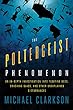
Michael Clarkson. The Poltergeist Phenomenon: An In-Depth Investigation Into Floating Beds, Smashing Glass and Other Unexplained Disturbances. New Page Books, 2011 -- Reviewed by Peter Rogerson.

Michael Clarkson is a Canadian journalist who has previously written a number of books on the general theme of the psychology of fear. His long term interest in poltergeists began with a visit, at of all times Halloween 1980, from a person who as a boy had been the centre of a poltergeist case 10 years before in St Catharines, Ontario. Clarkson admits he has never had a personal experience with a polt, but has interviewed many of the people involved in cases on both sides of the Atlantic, and presents a good selection of cases, including that Tina Resch and the infamous Enfield poltergeist. Another UK case was from Rochdale and featured the curious phenomenon of what seemed like rain appearing inside a house. Other cases are from Long Island, Connecticut, Florida, the Rosenheim poltergeist and the fifty year old Scottish case of Virginia Campbell.

Clarkson presents various viewpoints, though it is clear that his sympathies lie with the advocates rather than sceptics. This may well because the sceptics are represented by Randi - whose main purpose in all of this is more publicity for Randi rather than disinterested research - and his sidekicks. The main spokesperson for the advocates quoted here, William Roll, seems a much more credible advocate in contrast, certainly more so than some of the investigators from the U.K.

That being said there is no doubt that if the events in many of these cases occurred exactly as reported in the advocate literature they would be very difficult to explain in conventional terms, and one would have to assume a substantial degree of malobservation and reporting, along with a more complex scenario of trickery than the classical single 'naughty child' explanation. Perhaps in some of these cases not only are most of the members of the household involved in tricks, but so are extended family, neighbours, local youths and children, even reports and 'investigators'.

It is perhaps not surprising then that paranormal explanations have an at least a superficial appeal. Clarkson presents a number of interesting speculations and studies of people assumed to be 'poltergeist agents'. These have included discussion in terms of epilepsy, the 'fight and flight' response and repressed aggression However most of these explanations have massive problems. While terms like Recurring Spontaneous Psychokinesis (RSPK) have been invoked, no real, testable theories have ever been adduced to explain how patterns of electrical and chemical activity in the human body could throw furniture around, to say nothing of claims of apports and the like, evoking rather fashionable notions of zero point energy and quantum mechanics does not seem to greatly help in this regard. It is also extremely difficult to understand why, if such wild talents existed, they would not be as obvious and widespread as outstanding artistic, athletic or musical ability.

There is yet another problem, ask a paranormal advocate what a poltergeist or RSPK cannot do and you would be hard pressed get an answer. This means they are scientifically useless, infinitely elastic hypotheses. Explanations involving 'spirits' and other hypothetical entities have the same problems only worse. It is often not appreciated that anything that produces physical effects must be physical by definition.

Reading through this and similar books also raises another related problem, the discrepancy between the enormity of the claims and the efforts that are put into investigating them. Taken at face value, poltergeist stories hint at huge untapped sources of presumably renewable energy in an energy-poor world, so you would think that advocates would not stint any amount of time, trouble and money investigating them, and seeking to interest the scientific community in them, in hope of reaping the kudos and riches beyond imagination of if they could discover and harness. Yet when one suggests that proper scientific investigation should take place, the reply is less than positive. Could it be that the advocates don't really, really, believe in their own claims, at least as not occurring in the same reality as that of their wallets?

These accounts suggests that while there may be no agreement as to the mechanisms behind them, there might be better consensus on their psycho-socio-cultural meaning. They seem to involve the subversion of the idea of the home as an orderly refuge from the outer wildness. The poltergeist home is literally a disorderly house, an anti-home. Poltergeists are clearly related to that perennial teenage activity, vandalism. In contrast however to normal vandalism, this is an inwardly directed vandalism, and if one thinks of the home as an extension of the self, then it suggests that poltergeists may be related to both self-harm and Munchausen's syndrome. The poltergeist events seem like an ostentation of deep personal and family chaos and disorder.

People with Munchausen's Syndrome have been noted as extremely manipulative, and having an nearly unlimited need for attention, as well as an almost uncanny ability to latch onto the inner weaknesses of those dealing with them. Similar profiles have been associated with a number of the people involved with claims of Satanic abuse, 'multiple personality' and the like.

Deep family tension and repressed aggression seems to run through many of the accounts presented by Clarkson and to have been noted by those investigating them. I rather suspect however that they may not be fully appreciating how deeply disturbed and disturbing a proportion of the individuals and families that they are dealing with may be.

20.1.11

A SEXUAL OUTLAW

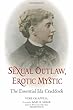
Vere Chappell. Sexual Outlaw, Erotic Mystic: The Essential Ida Craddock. Wieser Books, 2010 -- Reviewed by Peter Rogerson

Ida Craddock (1857-1902) was a pioneering American sexologist, who eventually committed suicide rather than face a long prison sentence imposed upon her through the actions of the moral entrepreneur Anthony Comstock. This book, by an officer of the Ordo Templi Orientis, provides a basic biography and a selection of her works.

What makes her story worthy of note in Magonia, is that she claimed to have been taught the arts of sexual ecstasy and the secret symbolism of belly dancing by her heavenly bridegroom, Soph, i.e. a ghost. Soph is supposed to have been the spirit of "a young man whom Ida had know when she was a teenager" a business associate of her mother's and frequent visitor to her household, who would always find some excuse to chat and joke with a Ida and give her presents, but who died before she reached adulthood. It is perhaps odd that Chappell doesn't even raise the possibility that Ida was the victim of sexual abuse. Whatever the case Ida recounted her experiences with her phantom lover in much detail in her diaries.

To back up her claims, she made an exhaustive study of the history of erotic relationships between humans and angels, spirits, incubi and succubi and the like since ancient times in a rather rambling work entitled Heavenly Bridegrooms, reproduced in this volume.

The idea of spirit spouses is one which occurs in a number of shamanic traditions, and, of course, reappears in modern UFO lore with such figures as Elizabeth Klarer, the South African contactee who claimed to have borne a child by her alien lover. Ms Craddock however would have been less impressed by abductees claims of meetings with hybrid children, as she would have assumed they were delusions implanted by negative spirits.

Beliefs that one has had sexual relations with non-human (or non-corporeal, a contradiction in terms surely!) entities might be more widespread than one supposes even now, as witness the numerous tabloid tales of 'randy spooks'.

Few modern psychologists would take such stories at face value, though few would seek to send those who told them to a mental hospital, as happened Ida for a time. They are more likely to be regarded as fantasy prone personality, one feature of the standard description of fantasy proneness was sexual fantasies so vivid as to lead to orgasm, which would certainly have fitted Ida. See also http://magonia.haaan.com/2009/fpp/ for more on fantasy prone personalities.

17.1.11

LIGHT FROM THE DARK

Dark Lore, Volume 5., edited by Greg Taylor. Daily Grail Publishing, 2010. -- Reviewed by John Rimmer

This edition of Dark Lore continues the pattern of presenting articles on a wide range of subjects from different viewpoints. In his introduction editor Greg Taylor comments that some reviewers (not us, I hope) have been rather sniffy about the mix of academic and speculative approaches. He rightly dismisses this criticism and vows that Dark Lore will continue as before.

Amongst the more speculative articles here is a piece by David Luke, examining disembodied eyes, including Tibetan eyeball serpents encountered whilst smoking dimethyltryptamine, and various other over-eyeballed creatures associated with various drugs. This particular piece, I regret to say, went, in the memorable phrase, right over the point on the top of my head.

Three chapters relate specifically to UFOs, all from a Magonia viewpoint. Martin Shough examines the early reports of Kenneth Arnold's experiences and is able to demolish the claims that the 'flying saucer' meme was the result of a careless bit of sub-editing. Shough lays out clearly the sequence of events in the reporting of Arnold's original sighting, and tracks the changes in descriptions presented by Arnold over subsequent years. An meticulous piece of detective work from one of the most painstaking UFO researchers.

Two other UFO-related articles take a specifically Magonia-like approach. Nigel Watson reviews the legends of skyborne ships and arial lands in folklore, specifically addressing the nature of 'Magonia' itself; while Theo Paijmans looks at encounters with folkloric entities in more modern times. He quotes a number of 'leprechaun' type creatures which have appeared to groups of schoolchildren in Dubuque and Detroit, USA, but he appears unaware of the famous Liverpool Leprechauns in 1964. Most remarkably he has uncovered in newspapers of the 1900s, a selection of stories, penned by children, which combine the elements of fairy encounters and early airship reports.

Still in classic Magonia territory, Richard Andrews tries to decode the meaning behind crop circles, or more specifically the motivation behind those who hide codes in the circles they create. His essay demonstrates that just because the crop circles are of human construction, this does not mean they are without mystery and power.

Philip Coppens looks at the possibility of a hidden 'angelic society' influencing the work of artists from the Italian Renaissance onwards, and Eric Davis searches for an occult input to the fictional work of the arch-rationalist H. P. Lovecraft, which has resulted in chaos magicians using his literary devices as part of their occult workings.

Two cryptozoological pieces by Nick Redfern and Neil Arnold present reports, respectively, of mammoths surviving into historical times, and an ambiguous horror in a park in Columbus, Indiana. Elsewhere, Robert Schoch's speculation that the moai of Easter Island were moved by a lost technique of levitation fails to convince, nor does Blair MacKenzie Blake's revisiting the Dogon and the Sirius Mystery.

Dark Lore editor Greg Taylor presents a potentially important critique of Martin Gardner's demolition of the SPR's account of the Mrs Piper trance medium case of the late nineteenth century, involving such psychic luminaries as Frederic Myers and Sir Oliver Lodge. I'm not sufficiently familiar with either the original reports or Gardner's criticisms to be definitive about this, but Taylor's documentation does seem to be convincing.

Mike Jay's 'Man of the Year Million' looks at how H. G. Wells's vision of the future of man gradually changed from an optimistic idea of Darwinian progress to the despairing vision of the last pages of The Time Machine. He covers some of the ideas touched on in Magonia by Martin Kottmeyer with his authoritative Magonia series 'Varicose Brains'.

In all, a well-chosen and interesting collection, justifying Greg Taylor's intention to keep Dark Lore as an eclectic mix of contributions.

[Note: this book is available in paperback, and as a de-luxe hardback edition]

VICTORIAN OCCULTISM

Alison Butler. Victorian Occultism and the Making of Modern Magic: Invoking Tradition. Palgrave Macmillan, 2011 -- Reviewed by Peter Rogerson

Many people today tend to view the Victorian period as one of dour Puritanism and dull conventionality, however the reality was often very different, and in many ways it was more tolerant than our own age is of various forms of dissidence and eccentricity. One manifestation of that eccentricity was the commitment of a number of solid members of society to forms of ritual magic. One of the most prominent examples of this was the Society of the Golden Dawn.

In this book, Alison Butler, who teaches history and religious studies at St Francis Xavier University in Nova Scotia, presents a sympathetic study of the Order of the Golden Dawn and the various influences from which it synthesised its ritual She sees it as inheritor of traditions of ritual magic which went back to the Renaissance, and developed through the eighteenth and earlier parts of the nineteenth century, while its more immediate origins lay in the various "Rosicrucian" orders of the early to mid 1nineteenth century, themselves descended from various forms of Freemasonry. One must remember this was a century in which many forms of quasi-Masonic organisations flourished, such Foresters, Druids, Elks and the like, and formed a substantial part of civil society, performing many of the tasks now performed by the welfare state.

Alison Butler traces the long development of this occult tradition and the history of the Order, and of the various personalities involved, along with their numerous quarrels, though perhaps some of the eccentricities of the likes of Samuel Liddle 'McGregor' Mathers (for example the latter's Jacobitism) are not always highlighted.

One of the more interesting forerunners of the Golden Dawn was Anna Bonus Kingsford, medical doctor, occultist and animal rights advocate, who claimed to have killed two French vivisectionist's through occult means, though never getting her true archenemy Louis Pasteur. One suspects that if Ms Kingsford were alive today she would be a member of the Animal Liberation Front, putting bombs under peoples' cars.

For Magonia's readers one of the more amusing sections is the account of the tea heiress Annie Horniman's astral trips to the various planets in the solar system, including Saturn which she envisioned as a dying planet populated by largely sexless, psychic, winged individuals, who lived in a gloomy city, on a diet of yellow and blue fish and coarse grain. Jupiter, on the other hand, was inhabited by the sort of improved people that certain kinds of Victorians dreamed about who, like the aliens encountered by modern contactees, bemoaned the wickedness of Earth; while the Martians spent their spare time between wars quarrelling with one another. Venus on the other hand was a world of great natural beauty and peaceful anarchy.

One of the features that Butler sees as significant at the end of the nineteenth century is the move of magic from being a largely solitary activity, to a group activity, a tradition continued and enhanced by the modern pagan movement. Perhaps this was another example of Victorian clubabilty.

Butler is surely right in sensing that these occult groups developed as a simultaneous reaction against the often gloomy Evangelical Christianity of many of the participants' backgrounds, the industrial present and the new materialism of the post-Darwinian scientific world. The rise of magical movements like the Golden Dawn may therefor be not unrelated to the general cult of the medieval and Gothic which inspired much Victorian art and literature.

16.1.11

JADOO TO YOU TOO

With thanks to Doug Skinner's marvellous John Keel Blog for giving a link to this delightful little number apparently issued to promote the release of Keel's eponymous book. Doug explains:

John Keel’s first book, Jadoo, was promoted in many ways: interviews, excerpts in magazines, and a Keel snake act in a Manhattan store window. There was also a song. I don’t know who wrote or performed it (and John didn’t remember); I don’t know if it was ever released or aired. But — now you can listen to it on YouTube.

Many thanks to Anthony Matt and Geoff Brady for restoring the scratchy 78; and to Angela Alverson for posting it.

The John Keel blog is full of fascinating material about one of Magonia's father-figures. I've added it to my 'Sites Worth Seeing' listing. Meanwhile mix yourself a very dry martini, sit back and listen to the smooth lounge sounds of the Jadoo Song:


11.1.11

RANDI'S PRIZE

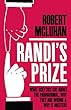
Robert McLuhan. Randi's Prize: What the Sceptics Say About the Paranormal, Why They Are Wrong, and Why It Matters. Matador, 2010 -- Reviewed by Peter Rogerson

Robert McLuhan makes some very valid points about many of the sceptical writers on psychical research and parapsychology, in particular the way that many of them dismiss the subject with a wave of the hand or through polemic, tend to quote one another uncritically, and rarely do justice to the original reports. Nearly as many of them think that the subject is so self evidently ridiculous that it is not worthy of serious consideration.

That being said, I am not convinced that McLuhan has all that much grasp of the complexities of the topic himself, and his attempts to bracket all critics of his interpretation of the data of psychical research along with Randi is quite mistaken. He fails to understand that a good number of psychical research's critics from Theodore Besterman and Eric J Dingwall (neither of whom feature in the index) down to Susan Blackmore and Chris French started out as "believers" and only became sceptics over a period of time.

As one goes through this book, what starts of looking as though it was going to be an attempt at an open minded look at both sides of the argument, became increasingly skewed towards a spiritualistic interpretation, with most other outlooks dismissed in much the same manner as he accuses the sceptics of doing.

It is true that many "normal" explanations of paranormal experiences do not really do the experience justice or provide a satisfactory explanation of what is going on, but what is not acknowledged by advocates of the paranormal is that their own explanations (if one can call them that) do not really explain the data either, and often contain logical contradictions.

For example McLuhan seems to take a fairly literalistic explanation of out-of-the-body experiences as opposed to the psychological theories proposed by Susan Blackmore and Harvey Irvin (the latter not mentioned, perhaps because as an author of a standard textbook on parapsychology he is not easily bracketed with James Randi). Yet such literalistic explanations cannot be right, as no invisible entity could possibly gain any visual information from the outside world (a point made by C. W. K. Mundle in the Proceedings of the SPR back in 1973). McLuhan seems to grasp this at one point and comes out with the old chestnut that what is experienced is some sort of "astral" equivalent of the physical world. Either this means something like virtual, which is what Blackmore and Irvine argue, this virtual world being the model of the world stored in the brain, or it doesn't actually mean anything at all.

Though McLuhan avoids some of the worst excesses of advocates of the paranormal, such as the arguments from authority and quotation which are rife and in the field, he does share some traits with them. One is a strange naivete which extends well beyond the paranormal, such that at times you wonder what planet this guy is living on. He cannot believe that the Fox sisters fooled people including their parents for any length of time, or that children could cause the havoc in poltergeist cases and scare adults out of their wits, because he cannot imagine his own children doing that.

He seems to have no grasp of the world of problem children in problem families, where generation after generation after generation of children and adolescents have engaged in vandalism, anti-social behaviour, bullying and manipulation. No doubt it is difficult to imagine that then antics of local children and adolescents can drive adults to suicide, that young children can drop concrete blocks onto motorway traffic or murder toddlers, or that parents might stage the kidnapping of their own children, but these things happen.

It is also clear that like many writers in this field, he is mainly looking at the material produced by psychical researchers not as puzzles to be solved but as ammunition to be used in a wider struggle against secular scientific naturalism, which means they have little chance of getting any kind of sympathetic reaction from the scientific community they are out to overturn. Also like many writers in this field McLuhan makes little attempt to understand or come to terms with contemporary studies in psychology and neuroscience. What paranormal advocates have to understand is not only do they have to provide repeatable experiments or observations and provide a theory which clearly explains (in mathematical terms if not everyday language) what exactly is going on in these anomalous events/experiences, but also that theory also has to explain, at least as well, and preferably better, all known, normal phenomena as well.

9.1.11

MAGONIA ONLINE

When I started this blog after closing Magonia as a print magazine, it was never my intention for it to become an "Electronic Magonia", intending to reserve it for book reviews and my own occasional ramblings, as well as those of The Pelican and our Northern Echoist.

Likewise the main Magonia Online website http://magonia.haaan.com/ was intended simply as an archive of the forty years worth of articles which have appeared in Magonia and MUFOB in its various incarnations.

But since setting them up, I have had people asking me if Magonia Online was willing to publish original articles, such as would have appeared in the print magazine. Well, yes, is the answer, and to start I have recently posted a new article by a regular Magonia contributor, Gareth Medway, where he looks at the nature of hoaxing, and how it may be detected. Read it HERE .
I'd be very happy to receive any other contributions of original material for publication on the site, and if necessary will arrange a dedicated link to them from the contents page. If you are interested in submitting Magonia-ish material, just drop a line to johnrimmer@rocketmail.com.

7.1.11

DEBATING PSYCHIC EXPERIENCE

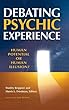
Stanley Krippner and Harris L Friedman (Eds.) Debating Psychic Experience: Human Potential or Human Illusion. Praeger, 2010 -- Reviewed by Peter Rogerson

For some thirty years now there has been a fierce polarisation between advocates of the reality of psi phenomena such as ESP and their critics, herein called counter advocates. Readers might wonder whether in this book, in which both sides have their say, there will be any meeting of the minds. There isn’t.

There is a weak introductory piece, adapted from a book, by Dean Radin, a flash-by history of psychical research padded out by accounts of other scientific developments, which serves no obvious purpose, but perhaps highlights how little parapsychology has progressed over the years.

There are replies to this by critics James Alcock, Ray Hyman, Chris French and Michael Shermer. Shermer’s piece, a lightweight ‘how I pretended to be a psychic and fooled gullible people’ account is very weak and like Radin’s introduction the book would have been better off without it.

The critiques by Alcock, Hyman and French are more substantial, though there is much duplication between them. Though Alcock produces no fewer than 13 objections to parapsychological claims, ranging from his agreement with his main opponents that psi “cannot occur if modern materialistic science is right”, an over strong claim one suspects, to more plausible critiques, such as parapsychologists inability to boundary their field (is there nothing they won’t believe in essentially, through negative definitions, misuse of the term anomaly, lack of replication by outsiders etc etc.

Hyman like Alcock narrows down the discussion of anomaly, arguing that real scientific anomalies are precise deviations from some sort of previously known norm, and both Hyman and French look more closely at replicability, Hyman arguing that many studies are supposed to show replicability, while French concedes that many mainstream psychological studies show similar poor levels of replication. Hyman also devotes much attention to the problems of meta-analysis

Replying to this Chris Carter and Dean Radin argue that the evidence is stronger than the critics would suggest, and that indeed studies that critics claimed did not show replication actually did. By now the argument seems quite seasonal, for it has a pantomimic quality of the “Oh yes they did, Oh no they didn’t variety”, good fun for the children but not especially enlightening. While they make some good points, and in particular refer to neurological studies in the mainstream literature, which the critics never refer to, they weaken their case by long polemical attacks on the critics, alleging that they are motivated by a whole range of psychological and ideological issues, have massaged the data and so.

As both make strong transcendentalist claims for the data anomalies, they raise the suspicion among their critics that they engage in parapsychology not to study open-mindedly what causes non-chance results, but to accumulate ammunition to use against 'materialism'. These transcendentalist claims lie rather uneasily alongside their appeals to quantum mechanics, which provides some good ammunition to their critics. They are also show a tendency, much marked among parapsychologists and psychical researchers to argue from authority and quotation. Listing all the great and good of past generations who said things favourable to parapsychology makes very little sense, as no doubt one could assemble large numbers of authorities to argue the other way, or to argue for all sorts of now discredited causes and beliefs.

Equally the argument that until the arrival of scientific materialism most people believed in ESP, and most still do, but there are precious few university posts in ESP, proves there is some huge conspiracy against, carries rather less weight when one realises that before 'scientific materialism' most people believed in witchcraft, astrology, demons and the like, and many still do. So presumably the absence of a Hogwarts Chair of Spells at Yale and the Russell Grant Chair of Astrology at Cambridge is also part of the same conspiracy.

As the critics reply to the parapsychologists, we get bogged down into more and more detail of Ganzfield studies and meta-analysis. However Hyman makes perhaps the most telling point, that all aspects of mainstream science have at least some “paradigm experiments”, experiments that any first year university student or high school student can perform, and teachers know if they use the right apparatus in the right way, they will get the desired result. He also makes the point that quantum mechanics leads to many demonstrable results and can be defined in precise scientific terms, so that however weird its results, scientists have to accept them.

A particular example might be the experiment which reveals one of the most counter-intuitive results from quantum mechanics; the experiment where photons are fired at a double slit one at a time, but interference patterns gradually build up. This is an experiment which can be performed in any decent university physics lab (and in many a well-appointed high school) anywhere in the world. It can be demonstrated time after time, there is no question of the interference patterns not turning up if there are skeptics in the room because the photons don’t like their negative vibrations. To be taken seriously parapsychology needs its own double-slit type experiment.

There are then two additional pieces, one by critic Richard Wiseman, argues that parapsychologists have all too frequently hopped from one experimental procedure to another in pursuit of promising looking leads which eventually get nowhere. They need to stick to a set of procedures which have looked the best and keep on that them. He does not address the specific criticisms made of him by Carter.

The second by advocate Stephen Schwartz lumps critics of parapsychology along with opponents of evolution and critics of the theory of anthropogenic global warming as deniers. Of course this tactic, as critics of human-caused global warming constantly point out, is simply a cheap rhetorical trick aimed at delegitimising the other side by linking them with Holocaust deniers. This is a particularly dangerous trick for a parapsychologist to engage in because critics will point out that evolution is accepted as a fact by the overwhelming majority of the scientific community, and there is a substantial majority opinion in favour of the theory of human-caused global warming, whereas it is the parapsychologists who are the minority outsiders. The tables could easily be turned and parapsychologists denounced as 'materialism deniers' who oppose the overwhelming evidence that consciousness is a property of embodied brains-human and animal.

In the round up, advocate Krippner and agnostic Friedman give their own views, as do 'moderate' advocate Damien Broderick and 'moderate' skeptic Elizabeth Loftus. These last four make better arguments for their point of view than do the main participants.

It is quite impossible for the outside observer to make much of many of the detailed accusations and counter accusations about replication with not just access to the original literature but the original laboratory workbooks and the buildings themselves. Despite both sides avowal of open mindedness I strongly suspect that in reality there is very little chance that any evidence would come along that would get Alcock and Hyman to change their skeptical opinions, and no chance at all that anything could persuade advocates Radin, Carter and Schwartz to change theirs. In the debates here the skeptics win on points, but whether that is a fair result is a moot point, because Radin, Carter and Schwartz made such poor advocates for their own positions.

Reading these papers began to give the impression of watching a very strange football match where one side was playing by the rules of Association Football, the other by those of Rugby League. Both sides are constantly moving the goal posts, and a high proportion of the scoring is generated by own goals. Nevertheless I came to some preliminary conclusions which I suspect are not going to be too far removed from the actual situation.

Much of the evidence comes in the form of esoteric and ambiguous statistical analyses, which can be interpreted with reasonable sincerity by each side to suite their own beliefs and prejudices. Despite that there are a number of cases of very puzzling above-chance statistical correlations which are more difficult to explain in conventional terms than critics would like to believe.

Advocates on the other hand need to be reminded that correlation does not necessarily equal causation. Advocates tend to be their own worst enemies. In particular, much of their transcendentalist rhetoric gives the impression than they are less interested in a truly open minded examination of what might be giving rise to above-chance correlations, than as using them as ammunition in a cultural war against secular scientific naturalism. This automatically raises defensive hackles of much of the scientific community.

Equally reasonable critics of parapsychology could lessen parapsychologists suspicions of them by avoiding getting involved in moral crusading organisations such as CSI(COP).

5.1.11

GHOSTS AND MEN OF QUALITY

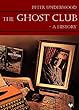
Peter Underwood. The Ghost Club: A History. Limbury Press, 2010. -- Reviewed by John Rimmer

The Ghost Club, as described in this slim volume, seems a rather strange, but very interesting organisation. Peter Underwood recounts a number of early starts in the nineteenth century. A 'Ghost Society' was first set up in Cambridge in 1851, its members including both a future Prime Minister and a future Archbishop of Canterbury. So the social level of the organisation was determined from the start

This eventually became mixed up with a rather vague Ghost Club Version II which was set up in 1862 or thereabouts in London, and included amongst its members characters such as the Headmaster of Westminster School, the Lieutenant Governor of New Brunswick and "other men of quality", as Underwood phrases it.

Version II didn't last long, but with the development of Spiritualism in the USA and England, interest revived and Version III was set up in 1882, which was again the exclusive preserve of "men of quality". Some of the details of the operation of this Club are very revealing. It seems to have been run as a combination of a London Gentleman's Club such as Whites or the Carlton, and a public school; both worlds which would be familiar to its members.

Meetings started with a ceremonial roll-call at which members present stood and called out "Here" as their name was called. When the name of a deceased member was called, the President proclaimed "Passed on". The meeting consisted of a formal dinner, after which a member would relate some personal experience of haunting or the occult. Members referred to each other as 'Brother Ghost' and membership was strictly by invitation only, with the threat of being 'blackballed' always hovering over potential members.

Naturally no women were allowed, although in 1926 an Annual Ladies Guest Night was inaugurated. Clearly the Suffragettes did not campaign in vain!

To be fair, during the course of these meetings a great deal of interesting material was discussed, although there seems to have been little critical examination of the evidence presented by the speakers - this was, after all, primarily a gentleman's social club.

By the 1930's the Club was in decline, Underwood suggesting that by then most members had heard each others' anecdotes rather too many times! In 1936 it was wound up with its records finding their way to the British Museum (now in the British Library) with a 25-year embargo on them being opened.

Version IV was started by Harry Price in 1938. This version seemed to have a rather broader recruitment policy than its predecessors, membership now extending to 500, but still dominated by men (and now women) of quality; people like Siegfried Sassoon the poet, Osbert Sitwell, Robert Gibbings the wood-engraver and travel writer, and a certain Cyril Wilkinson, described as a "society ear piercer" - how exactly do you get a job like that?

There were also, however, people who were active in the field of psychic research such as Dr Soal and Kathleen Goldney of the SPR. The meeting were again held over a formal dinner, but some quite interesting topics were discussed, and usually from guest speakers rather that relying on the membership's anecdotage. Version IV faded away after the death of Harry Price, who seemed to be the motivating force.

1954 saw the birth of Version V, operating under a distinguished Committee including the society ear-piercer, and with Peter Underwood emerging as President. Much of the rest of this book is basically a summary of the minutes of the Club meetings, with a list of speakers and topics discussed. And also it's the point at which we start to meet some of the many ghost-hunters and psychical researchers who operated at a slightly less elevated strata of society than in the Club's earlier incarnations. There also seems to be evidence of some actual research being done, and members venturing beyond the confines of London's clubland.

Gordon Creighton was a member and is described as "of Fortean Times fame" which rather puzzled me. I had the unworthy thought that it might not have been considered de rigeur to have acknowledged his links to flying saucers, but noticed that later on he did actually speak on 'The Mystery of Flying Saucers'. However the author is careful to note that he did this "with his background of 25 years in British Diplomatic and Intelligence work in Europe, the Americas and the Far East".

A few other familiar names begin to creep in at this point, too: Jenny Randles spoke on 'UFO Retrievals', Hugh Pincott of ASSAP on Uri Geller, Mary Caine explained the Glastonbury Zodiac, Mick Goss spoke on his specialist subject of the phantom hitch-hiker, and Charles Bowen and Hilary Evans both paid a visit.

And so did I. Or did I? This account ends very suddenly in 1993, with the announcement that "Bill Bellars saw himself in authority. He was suddenly and unkindly critical of me and everything I had done". Bill seems to have sprung out like the Demon King from a pantomime trapdoor, and there is no mention of him anywhere earlier in the narrative. I had to check Google to find that he was "Polaris submariner Cmdr Bill Bellars OBE". Distinguished ex-military types being very much part of the establishment of the Ghost Club in all its versions.

This usurping of Peter Underwood from his 'President for Life'-type role caused the Club to split in two; Bellars leading what appears to be a rump 'Ghost Club', with according to Underwood, about 80% of the membership leaving to form a Continuity 'Ghost Club Society'. It was one or the other of these that I spoke to some time in the 1990s, at rather elegant premises just off Connaught Square in Bayswater, but to my shame I cannot remember which!

This is, as I have said, a very slim volume (44 pages plus 12 pages of photographs) and very specialised in its content, so I doubt it will be of much interest to the general public, but I am sure anyone connected with the Ghost Club, in any of its versions and offshoots will certainly want to have a copy.

2.1.11

NASA CONSPIRACIES

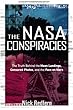
Nick Redfern. The NASA Conspiracies. New Page Books, 2010. -- Reviewed by John Rimmer.

The publisher's blurb that came with Nick Redfern's book begins, "He's at it again! The notorious and enjoyable author Nick Redfern ... ". Well, I wouldn't argue with either of those descriptions when reading The NASA Conspiracies. Mr Redfern appears to be one of those generously open-minded people who attract a great number of eccentric characters. Reading this book is a bit like being stuck in a bar with a group of rather odd people telling amazing tales over a few, or more, drinks. Not a bad thing in itself, and rather how I would like the 'Magonians in the Pub' meetings to be!

Although it's clear that Redfern has his doubts about many, if not all, of the stories he is told, he relates them in the manner of the non-judgemental therapist who may well think that his client is, in technical terms, nutty as a fruit-cake, but nevertheless believes that the stories they relate are of value in understanding their mental state.

One of the most interesting tales recounted here is the story of 'John'. John approached the author after reading his book Bodysnatchers in the Desert, with its heretical claim that Roswell was not the result of an ET crash, but part of a grotesque US experiment using tragically deformed human beings. John explained that he was someone with a long and distinguished career in the New York Police Department and later in a number of other security-related organisations, which included involvement in a successful operation to trap a Soviet spy. In 1971 he was offered a job with "a certain highly secret arm of the US intelligence community operating out of Nevada..."

Got it in one: Area 52.

He was chosen because, as well as his impeccable career record, he was unmarried, had no children or any living close relatives. His work in Nevada involved 27-day stints at the secret location, and then three or four-day visits to Las Vegas where he could avail himself of the services of high-class hookers, with the full approval of his employers.

When he travelled from Las Vegas to the site it was in a plane with the window-blinds closed. On landing he was obliged to put on a strange pair of goggles which obscured his view in all directions except downwards, and in that state was guided onto a bus, again with blacked-out windows. Still wearing the goggles he was taken to a building which was the entrance to a lift-shaft, where he descended two floors, and passed through a variety of security checks, to his underground workplace.

His job in this underground bunker seems to have been that of an archivist, supervising a collection of documents from NASA and other government agencies covering the era from 1943 to 1968. As he read through these he came across references to a group of 17 very strange people who were apparently found wandering around the Arizona desert at some date in 1943. Although these 'people' seemed to have had many features in common with the classic 'grey alien' there were also significant differences, and there seems to have been no connection with Roswell or any crashed UFO reports. The investigation of these creatures reads like a Dr Who script, with descriptions, amongst other weirdness, of shape-shifting clothing that invades its wearers mind!

I was impressed by the fairytale-like character of this story: John seems to fulfil the role of the 'orphan' or 'foundling' with no family, who is taken to the mysterious 'underworld' - the strange glasses and blacked-out vehicles being part of the liminal transition zone - where he is shown treasures and hints of greater mysteries, and rewarded with gold (a "very good indeed" salary) and sexual favours. Curiously for such a high security posting, John's stay in this strange subterranean world was for just a year. But if we were able to check his contract details, I wonder if we might find it to have been for a "year and a day"?

Not all the chapters reach this level of strangeness, and some, especially on the so-called 'Moon Landing Hoax' and claims of sabotage to the space shuttle are straightforward demolitions of the conspiracy theories. We also get such old favourites as the Face on Mars, Kecksburg, NASA's curiosity about UFO reports in South America and Europe (but with no mention of Rendlesham, I notice), and indications that NASA, or at least some of its employees, have at times demonstrated considerable interest in contactees and abductees.

I was particularly intrigued by the chapter 'The Monsters of NASA' which details a number of reports of bizarre Mothman-like creatures seen in and around (in some cases on top of) NASA installations, some of which seem to link to the chupacabra stories in Puerto Rico.

I don't suppose you could take more than 5% of the stories related here as having any basis in objective reality, but they provide a very useful survey of the level and nature of belief - and of distrust and suspicion - in what is sometimes referred to as the 'UFO community'. For that alone, this is a book worth reading.

Now I think I've got to go to the bar and get another round in ...

MAGONIA RECOMMENDS