30.3.11

BACK FROM THE DEAD!

In the greatest comeback since Raith Rovers dramatic 7-6 victory over Forfar in the third round of the Scottish Cup in 1953, John Harney has re-opened his Magonia blog as 'Magonia Extra' at:
http://mufob.blogspot.com/ 

John will be using this primarily for taking a hard look at some classic UFO reports and writings, and general comments on the current UFO scene. His first article looks at a strange case of phantom helicopters reported in connection with Whitley Strieber's UFO experiences. John's other blog, Magonia Supplement, remains as an archive site.

The blog you are reading will remain the main location for book reviews, The Pelican's column and Peter Rogerson's Northern Echoes, as well as my own ramblings, and also for publishing contributed material which will subsequently be transferred to the archive website.

28.3.11

WHAT COLOUR IS YOUR PARAGRAPH?

V. S. Ramachandran. The Tell-Tale Brain: Unlocking the Mystery of Human Nature. William Heinemann, 2011. -- Reviewed by Peter Rogerson.

Ramachandran, who is Director of the Center for the Brain at the University of California, San Diego, here continues his study of extraordinary cases in neurology which he began in Phantoms in the Brain. Here he covers in additional detail topics such as synesthesia, phantom limbs and the strange effects of various brain injuries caused by both strokes and injuries, as well as studies on autism. These show how much of our perception of the world is generated internally, and that indeed all our perceptions may be regarded as hallucinations informed by the information provided by the scenes.

These sort of syndromes, and perhaps others that have never come to medical attention may well give some clues as to what is going on in anomalous personal experiences. An example of this is provided by Ramachandran's study of mirror neurones, which showed that people might feel their phantom limb being touched when they watched someone else's limb being touched, and that this effect could be replicated in someone with a normal limb, if the limb is anaesthetised.

From this he concluded that mirror neurones are constantly activated, but their effects are normally repressed by information coming from the body. When this information is cut off by amputation or anaesthetic, the boundaries between the self and the other begin to disappear. This effect tends to validate the claims by early students of hypnotism that some hypnotised subjects could experience community of sensation, in this case we might assume that the hypnotic suggestion acts to disinhibit mirror neurones. Some of the phenomena of conditions like latah in which people imitate the movements of others may also have a similar cause.

The author also suggests that mirror neurones may play a role in folie a deux, and one might wonder if they are not also involved in cases of "mass hysteria" and "collective hallucination" and perhaps a wide range of apparently collectively experienced anomalous phenomena.

The author suggests that the ranges of pathologies, quasi-pathologies and benign differences may give important clues to the development of human consciousness, and suggests that we should emphasise more the difference between humans and other animals, and not just concentrate on the similarities. He also devotes a significant discussion on the psychology of art and aesthetics.
  • Maureen Seaberg. Tasting the Universe; People Who See Colors in Words and Rainbows in Symphonies. New Page, 2011. -- Reviewed by John Rimmer.
There has been a number of recent books looking at the phenomenon of synethesia from a medical and academic viewpoint, such as Ramachandra's book above and this other recent title also reviewed by Peter Rogerson. There seems to be fewer describing the phenomenon from the percipient's viewpoint.

Maureen Seaberg was born with the ability of being able to discern letters, shapes and sounds as colours. At first she thought that this was quite normal, and that everyone saw the world in this way, gradually she began to realise just how unusual this was. In order to understand synesthesia she begins a journey to meet other people with this ability, and to try to understand what it has meant to their lives.

People she meets include musicians like the violinist Itzak Perlman, who sees individual notes as colours and shapes. Musical synesthesia is perhaps the best known form of the phenomenon, and was widely recognised at the turn of the 19th/20th century. The idea of the integration of different senses fitted in with the ideas of the Symbolist art movement of the period. Composers such as Scriabin, who was not himself a synesthete, wrote compositions which required the use of a 'colour organ' to produce washes of colour across the concert hall in concert with his music.

However, synesthesia seems to have been almost forgotten as a condition through much of the twentieth century, and Seaberg puts this down largely to the growth of behaviourist theories of psychology which emphasised external social and environmental influences rather than internal experience. Ironically one of the pioneers of behaviourism was Francis Galton, who was also the person who identified synesthesia as a condition and gave it its name.

The author talks to a range of writers, artists and musicians who have used synesthesia as part of their creative processes. Unfortunately at times these interviews come dangerously close to the style of a slightly breathless Hello magazine celebrity interview. They do, however, demonstrate the varieties of the synesthetic experience, which appears to vary greatly between individuals. While some have a direct visual or auditory sensation, others just have a very strong impression of a particular colour or shape when confronted by a stimulus, without it necessarily having a sensory experience - more a sort of "Mondays always seem green to me" sort of response.

Although sound to colour is perhaps the most common form of the condition, Seaberg describes her word-to-colour experience. Of course, any description of this phenomenon is almost impossible to anyone who does not actually experience it themselves. Despite being seemingly bombarded by colours, shapes and other impressions, synesthetes cope perfectly well with their environment. In the later chapters of the book Seaberg looks a deeper philosophical, religious and even parapsychological implications of synesthesia, and the effects of 'mirror neurones' as described by Ramachandra. Synesthetes seem to be particularly empathic, and more able to "feel your pain", which was a particular problem at times for the author, as in her professional career she is a crime reporter for a New York newspaper!

This book presents an intriguing insider's view of an experience which it is very difficult, if not impossible, for outsiders to appreciate. I suspect that we are going to find synesthesia increasingly involved with the kind of topics that we discuss in Magonia.

24.3.11

THE WARRINGTON WITCH

I have just posted a new article by Peter Rogerson on the Magonia Archive website. It follows on neatly from my review of the Pickering brothers' book, Witch-Hunting in England which I reviewed a few days ago. [LINK]

One of the most noteworthy lessons from that book was just how trivial some of the alleged actions were, which led to accusations, prosecutions, imprisonment and sometimes death sentences. However, later in the seventeenth century  the number of cases declined, to die out altogether in the early eighteenth century, although the idea of witchcraft, maleficia and the 'evil eye' hung around in popular culture for much longer.

Peter has discovered a remarkable case from the latter half of the nineteenth century in Warrington, the town where until recently he was the local history librarian. It demonstrates how persistent such ideas were, and maybe still are, especially when we start talking about issues such as 'Satanic' conspiracies, and some of the comments floating around abductees and 'hybrids'.

Can I just point out that Magonia Online is always open to original contributions on any of the topics that we discussed in the print magazine.

You can read Peter's account of this intriguing case HERE

20.3.11

KNOWING ME, KNOWING WHO?

Elias Aboujaoude. Virtually You: The Dangerous Powers of the E-Personality. W. W. Norton, 2011.

An American psychiatrist rehearses the many dangers of the Internet, from compulsive buying, gambling, watching porn, loosing your privacy, and drifting away from the real world into a much more exciting cyber one.

It is probably the section on the false and often inflated personalities that people adopt online that comes closest to the sort of topics covered by Magonia. It might be that this adoption of e-personality is a relatively mild form of what I have called Caraboo Syndrome (named after Mary Baker/Princess Caraboo [LINK]) in which people either create greatly inflated versions of their own lives or adopt completely fictitious identities.

Aboujaoude links this creation of e-identities to dissociative disorders which is also interesting. Perhaps, however, the best analogy is with the actor playing a dramatic role.

As a retired librarian I can sympathise with his comments on the replacement of books and reading by e-surfing and cutting and pasting, it is sad to see Britain's reference libraries being abandoned and run down because "everything is on the net".

That being said, much of this book's Jeremiads seem to echo many earlier concerns. From its early days psychiatry has been a rather conservative and to some extent puritanical and authoritarian profession, one which has often had the assumption that currently existing society is perfect and that its job is to fit less than perfect human beings into the system. Some of Aboujaoude's concerns about e-anarchy and what will happen without the right kind of gatekeepers echoes nineteenth century concerns among elite opinion formers about 'the Mob' and the terrible things they will get up unless restrained by their betters. And of course, there are more than echoes of the fears generated by the invention of the printing press and the start of mass publishing.

Other fears reflect the conflicts between the behaviour of complex, mixed-up, very diverse, really existing human beings and the demands of the capitalist system, For example Aboujaoude bemoans the blurring of the boundaries between work and leisure, but these boundaries are an invention of the capitalist system, with its factories and industrial discipline, and not the way traditional societies have behaved.

The Internet, he suggests is leading to a rise in so called attention deficit/hyperactivity disorder, most of whose symptoms seem more like natural childish behaviours than pathologies. Not considered is that children are not biologically programmed by evolution to sit at desks for hours at a time listening to teachers droning on. A more plausible cause of the rise of diagnosis of this disorder are social changes, such as the closing down of urban wild spaces where children could let off steam, growing parental fears and general lessening of tolerance of children's behaviour by an ageing population.

PSI OTT?

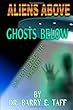
Barry E Taff. Aliens Above, Ghosts Below: Explorations of the Unknown Cosmic. Pantheon Press, 2010.

Dr Barry Taff, a former graduate associated of the late Thelma Moss at the UCLA's parapsychology laboratory, reports on a wide number of cases of anomalous phenomena that he has investigated. If his claims are true he would appear to have encountered more paranormal phenomena than the combined membership of the SPR in its near 130 years of existence, including the famed 'Entity' case which was made into a novel by Frank de Felita, and a film. He also reports on some UFO cases including a case of abduction and false pregnancy dating back to 1974. If there were actual contemporaneous evidence of this it would be very interesting, because it would suggest that the motive was out there in the community years before it was popularised by Budd Hopkins.

The cases reported here, if done so accurately, would defy just about any explanation, paranormal as much as normal, and bare more than a passing resemblance to the tales told by John Keel As with much of this literature the crux is on that "if". I must say there are some aspects of his claims that lead to caution, it is not just the sheer magnitude of the number of cases Taff claims to have investigated, but the dramatic quality of many of them, and the fact that a surprisingly large of them seem to revolve around attractive young or youngish women who remind him of well known actresses, and several of whom he dated. He also seems to have taken on board much of American ufolore, though not the claims of David Jacobs.

18.3.11

ENGLISH WITCHCRAFT AND SURREY GHOSTS

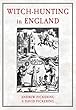
Andrew and David Pickering. Witch-Hunting in England. Amberley, 2010.

Marq English. Paranormal Surrey; True Ghost Stories. Amberley, 2011.

These two titles might well be used as examples on how to, and how not to compile gazetteer-style guides to paranormal phenomena on a regional basis.

The Pickerings' book looks at records of witchcraft trials and witch-hunts across England from the mid-16th Century when the effects of the first anti-witchcraft laws of the reign of Henry VIII were were felt. Prior to this witchcraft in England was seen as a civil action and anyone accused of practicing sorcery to harm a neighbour's health or their property was generally treated in the same way as someone accused of physically damaging crops or attempting poisoning

Henry VIII's act produced few prosecutions and soon fell into disuse. The more serious phase of witch-hunting began after the passing of an Act in 1563, under Elizabeth I. This was largely a response to presumed plots against the Queen's own life, as well as the influence of witch-hunts in several European states. It also involved changes in the way witchcraft was regarded by the authorities, following the Reformation, from being simply malevolent acts by one person against another to being 'conjurations' against God's law

Even then the punishment for witchcraft, even it was considered to have involved attempting to cause death, was imprisonment rather than execution, and it was not until the reign of James I/VI that the death penalty was introduced. Prosecutions and hangings (very seldom burnings) continued through the 17th century, and the panic was intensified through the years of the Civil War and the activities of self-styled 'Witchfinder General' Mathew Hopkins. However following the Restoration the practice began to die out. More and more frequently accused witches brought before magistrates were found not guilty, often to the fury of local people. The Pickerings describe a few cases in the early 1700s which lay claim to being the last witch trial in England. Eventually the popular panic faded away, until its surprising revival with the 'Satanic Abuse' allegations of the 1980s and 1990s. [For a curious late revival, see HERE]

The book lists the trials, county by county, and chronologically within each county. Reading the accounts one after the other, there are a number of clear impressions. One is the large proportion of trials which resulted in a not guilty verdict, or even the complete dismissal of the charge before it reached court. This seemed to happen more often if the case was referred to higher authorities than if it was determined at a local level. Another clear impression is the complete banality of the issues which triggered accusations - mostly in the nature of what would now be termed "giving someone a funny look

The descriptions of the trials also confound any claim that the witchcraft panic was an elite persecution of the peasant classes. In most cases socially there was little if any distinction between accused an accuser. Many cases were prompted by "charity refused". The supposed witch would have asked for some small item - food, a scarf or other piece of clothing and, for some reason in quite a few cases, a pin - and would then be accused of maleficia against the person who had denied them

The Introduction gives a good brief history of the whole episode, and the bulk of the book is a gazetteer of individual cases. Most of the descriptions are quite short, just a few lines of a court record, but there are many longer pieces on the more significant cases such as the Lancashire witches, Hopkins's rampage in the East of England and the Witches of Warboys.

Not the least interesting feature is the large number of reproductions of the title-pages of the various pamphlets and books which were published describing the alleged activities of the witches and their fates at trial. These clearly helped to whip up hysteria and create the atmosphere which allowed the hunts to continue

The clear and logical geographical and chronological arrangement of summaries is complemented by bibliographies of primary and secondary sources, and a comprehensive geographical index. For anyone wanting a good, straightforward account of the English witchcraft panic, this book is an excellent introduction

Paranormal Surrey continues Amberley's series of county-by-county guides of paranormal phenomena. Unlike some others, this title concentrates almost entirely on ghosts and hauntings. Most of the entries are very short, just a few lines with brief reports of shadowy figures or odd noises. It is difficult to make anything of these, as few if any references or witness accounts are given.

Many of the longer pieces describe investigations by the author's own investigation group, Spiral Paranormal. These seem to rely to a great extent on 'feelings' and mental images picked up by members of the team claiming mediumistic talents, with little evidence of serious attempts at scientific investigation using methods such as are well described in Amberley's Beginner's Guide to Paranormal Investigation, although there is reference to instrumentation in an appendix.

However my main gripe with this book is the unhelpful way in which it is arranged, just an alphabetical listing under random words. One entry is simply 'High Street'. Now my A-Z reveals that there are twelve High Streets in Surrey, but it's only when you read the entry you find that the one referred to is in Ewell. (The fact that this is fitted in the alphabetical sequence between 'Epsom House' and 'Fairlawns' doesn't help, either). There is no index to help the reader around this confusion

I imagine the first thing anyone buying this book would want to do would be to check on the spooky locations in their own area, but this is impossible. There are for instance seven entries for the suburb of Cheam, all scattered through the book, as are other nearby locations in the same borough. Would it really have been so difficult to have arranged these entries in a logical alphabetical manner under the names of the towns and boroughs concerned

Or am I just a crusty old librarian? -- Reviewed by John Rimmer.

15.3.11

VISIONS OF THE MULTIVERSE

Steven Manly, Visions of the Multiverse, New Page Books, New Jersey, 2011
There is general agreement among astronomers and cosmologists that about 13.7 billion years ago the universe we live in began with an event generally known as the "big bang" (a term invented by the astronomer Fred Hoyle, who was noted for his scepticism about the theory). It should be understood, though, that this does not mean that the universe expanded into space, but that it was space itself which expanded.

Much of this book is devoted to describing the development of the theories of special and general relativity, and quantum theory. The descriptions of the discoveries and properties of the various sub-atomic particles are fairly interesting. For example, some particles are not fundamental, but are composed of three other particles, called quarks, and these quarks come in six varieties, known as up, down, strange, charm, bottom and top. These descriptions, though, are perhaps not very enlightening to those of us who have not spent years studying higher mathematics and particle physics.

The most interesting part of the book describes the theories of the multiverse. The big bang theory by itself has problems, one of which is that by extrapolating the universe back to its beginning it collapses to a point of infinite density. Although it is possible to make calculations concerning what is thought to have happened a tiny fraction of a second after the big bang, the theory, according to MIT physicist Alan Guth (who described the universe as the "ultimate free lunch") "makes no attempt to describe what 'banged,' how it 'banged,' or what caused it to 'bang.'.

This and other problems with the big bang theory were tackled using an idea known as "inflation". Some physicists also use String Theory, which is based on the idea that fundamental particles can be considered not as points but as string-like objects. Manly attempts to describe these as simply as possible, but I suspect one would need to understand the mathematical treatments in order to make much sense of them.

These theories led to the idea of there being multiple universes, rather than just the one we live in. There are several different kinds of scientifically theoretical universes including, for example, the Fecund Multiverse, in which quantum gravity effects in black holes might lead to the births of new universes isolated by these black holes from the universes that spawned the black holes. There is also a Many-Worlds Multiverse, whose description is worth quoting:

In quantum mechanics, different quantum mechanical outcomes are separated in a mathematical space called Hilbert space. In the many worlds interpretation of quantum mechanics coupled with the concept of decoherence, these different realities emerge as distinct branches of the evolving universal wave function -- effectively parallel universes.
Of course there is also the question of our place in the universe, or universes. Manly briefly describes the discussions between scientists and philosophers on the connection between quantum mechanics and consciousness, and the fact that in the Copenhagen interpretation the collapse of the wave function is caused by observation. This is a topic, however, which appears to be more concerned with philosophy than physics and Manly, perhaps wisely, writes: "I will not attempt to do justice to this subject here".

Although the author has tried to lighten the tone with some of his jokes and witticisms, this book is not an easy read, so you will have to pay attention at the back, there! -- Reviewed by John Harney

14.3.11

THE MORALITY OF IMMORTALITY

John Gray. The Immortalization Commission. Allen Lane, 2011.

Charles Darwin's Origin of Species published in 1859 presented a word in which human beings were totally embedded in the general and very mortal biological world, and not a special creation destined for immortality. John Gray explores ways in which human beings have tried to escape that fate and construct a path to immortality founded on science rather than religious revelation.

The first example that Gray gives is that of the Society of Psychical Research, in particular the role of Henry Sidgwick and Fred Myers, both of whom, he suggests, may have been gay or bisexual. Sidgwick could not conceive of a system of ethics which was not based on God and immortality. Gray, a philosopher himself, has some fun with this proposition.

Ironically Gray argues, in trying to prove immortality, Sidgwick, Myers and the other members of the SPR actually accumulated evidence which tended to deconstruct the notion of a unified rational human personality. What, he suggests, these people wanted to survive was not their actual, complex, warty, personalities, but the people they would have liked to have been.

A central aspect of their work was the so called Cross Correspondences, a series of strange messages supposed to come from discarnate founders of the SPR. These read like some kind of surrealistic poetry and if the examples given here are anything to go by, the message was definitely in the eye of the beholder.

The cross correspondences were tied up largely with the extended Balfour family, its friends and hangers-on. One feature discussed by Gray is the attempt to create a new messiah, as revealed in Archie Roy's The Eager Dead. [LINK]

Another core association between the Cross Correspondences and the Balfour family was the so called Palm Sunday case, predicated on the claim that for the whole of his adult life the former Tory Prime Minister Arthur Balfour was in deep mourning for his one and only true love Mary Lyttleton. Gray argues that the evidence suggests that their relationship was nowhere near as close or significant as the SPR suggested, indeed Balfour's main relationship was a sadomasochistic one with Mary Wyndham, Lady Elcho.

In the newly created Soviet Union the search for immortality took, if anything, an even stranger form, in the form of the God Builders, who believed that scientific progress would eventually lead to human immortality and the scientific resurrection of the dead. This ideology had some impact on some members of the Bolshevik party in the 1920s, and was the main reason for the preservation of Lenin's body. The original, unsuccessful plan had been to freeze it so that a future science could revive it. The future humanity envisioned by the God builders and related groups was not as a biologically being, but as a disembodied spirit or energy, perhaps existing in cosmic space. Echoes of this theme can be found in the writings of Teillard de Chardin and in Arthur C. Clarke's Childhood's End.

Gray presents this story in the context of the relationship between H. G. Wells and Moura Budberg (also mistress of Maxim Gorky and suspected double agent) and the bloody violence of the Bolshevik regime, which shared Wells's general distaste for actual human beings. Rather than seeking to improve the lot of masses of really existing human beings, the Bolsheviks early on decided that the actual people were not good enough for the party and to try and replace them with the new model Soviet citizen.

Even today there are those who dream of using science to abolish mortality, such as Ray Kurzweil, who talks of the singularity in which, human beings will dematerialise into cyberspace. Like the post mortem 'entities' dreamed of by psychical researchers and the transcendent future beings dreamed of by the God builders, Kurzweil's virtual beings have left actual real, messy, biological human lives behind them. All of these groups, and Wells, were only really interested in the survival of elites, whether Cambridge classists or new model Soviet Citizens.

11.3.11

A GHOSTLY BRACE OF AC(Y)KROYDS

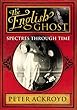
Peter Ackroyd. The English Ghost. Chatto and Windus, 2010

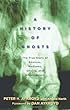
Peter H. Aykroyd and Angela Narth. A History of Ghosts: The True Story of Seances, Mediums, Ghosts and Ghostbusters. Rodale, 2009
    Some time deep in the mists of Brigantian history, somewhere near Halifax, the English novelist and historian Peter Ackroyd and Peter Aykroyd the father of US-Canadian comedian Dan Aykroyd came from the same stock, and it would seem they have both inherited an interest in the paranormal from the their distant common ancestors.

    There is not much one can say about Peter Ackroyd's The English Ghost, other than it is a collection of 'true' ghost stories from various periods of English history, with sections on haunted houses, ghosts of the road, poltergeists, phantom animals, crisis apparitions etc. A good proportion come from the Victorian period, and one can see here how they acted as templates for such writers of ghostly fiction as M. R. James. Most of the stories are very short, but have an atmospheric quality, which is presumably what Ackroyd found attractive about them. Given his views on place, memory and history, as demonstrated in his books about London, this book is surprisingly short on analysis, and it might be described, not too unkindly, as an up-market scissors and paste job.

    Canadian Peter Aykroyd's book is not, despite the title, about ghosts at all, it is a potted history of spiritualism, of which his grandfather Dr Samuel Aykroyd, dentist, humanist and socialist was a devotee. Dr Aykroyd held home circles with a pet medium who got nothing from this except, it would seem, free bed and board. Much of the history has been compiled from the notebooks compiled by Dr Aykroyd. Peter Aykroyd, who can remember the seances as boy, provides a history which is sympathetic but not entirely uncritical

    The interest seems to have rubbed off onto his sons Peter Jnr. and Dan (who is a member of both MUFON and the American Society for Psychical Research). They were both involved in a TV series called Psi Factor which seems to have been largely inspired by a guy named Chris Chacon, who claimed to represent the paranormal division of the Office for Scientific Investigation (OSIR). The OSIR was a real, rather clandestine organisation dealing a variety of mainstream scientific research, but the paranormal division looks very much like a complete fantasy (thousands of scientists with vast budgets investigating the paranormal and having experiences which make the X Files look tame), and seems to resemble nothing so much as the fictional APEN as if run by Steve 'dress code' Mera.

    10.3.11

    DISCLOSURE, IT'S HERE!

    Ufologists will be interested in a quote from Hansard (the record of Parliamentary proceedings) Written Answers to Questions, for yesterday:

    Mike Penning (MP for Hemel Hempstead): "... I have met with the MIB and have visited their headquarters in Milton Keynes".

    I think we could probably have guessed their headquarters would be in Milton Keynes, a town that seems to have been designed for habitation by aliens. (Hat-tip to Dizzy)

    9.3.11

    ABDUCTIONS AND HYBRIDS: STILL A DANGEROUS GAME

    Carol Rainey's article below gives insights into more than the activities of Hopkins and Jacobs, for it sheds light on how people become converts to new (to them) religious movements, and the mentality of closed communities which see themselves under siege. We all know of people who have converted to the religion of a new partner, particularly where that religion is a major part of said partner's life. When this religion is one which is seen as dissident by the newcomer's original community it can place huge demands on them. Often the newcomer for a time at least becomes more fervent than those who have held the belief for their lifetime. We can see in Carol's case some of the attractions of this - one can see oneself as part of a new community to which one must give total commitment, which offers what it claims are profound insights into the human condition, and gives the adherent the sense that they are in the front line of a cosmic battle.

    Of course the claims of any new religion are often difficult for the newcomer to accept In the case of abductionism this included biologically impossible claims of human/alien hybrids, and physically impossible claims of abductees becoming invisible or being sucked through solid walls. But that's the point of a high demand religion, it doesn't cost much to believe in things that are relatively easy to believe in, its believing the impossible which takes real faith. Of course the more impossible the things you start believing the more alienated you become from outside family, friends and the wider community, and the more you depend on the in group and its charismatic leader(s).

    Like all cult leaders Hopkins does not look for equal companions and colleagues in his life, but disciples; so it is no surprise that when Carol Rainey started to lose her new faith and ask awkward questions, she was ejected as part of the 'enemy', the dreaded unbelievers.

    The reaction of the wider UFO community to the first version of Carol's article when posted on UFOUpDates, and to the complaints of Emma Woods, resembles rather the reaction of the institutional Catholic Church towards allegations of child abuse - blame the victim and shoot the messenger. There is also an eerie similarity between this implosion and the collapse of the Middle Eastern dictatorships, the hysterical attacks on critics, and the cringing, arse-licking messages of loyalty to the dear and glorious leader who has sacrificed everything for you, his ungrateful children. When things really get tough going they can always fall back on the hate-fest. Up on the screens goes the picture of Emmanuel Goldstein Klass, and the whole people can shout abuse and rage at him. Anyone who challenges the great leader and wise helmsman is of course an agent of the imperialist running dog Klass, no doubt spending their time pissing in the peoples' beer, crapping in their burgers, sabotaging their factories and skinning their cats.

    What the supporters of Hopkins and Jacobs want to hide is that they have never once offered any real help or healing to their victims, only confirmed them in their worst fears, and told them time and again how helpless they are before the terrible greys, reinforcing dependency some might call it. What they and their ilk are doing is finding frightened and confused people who have had unnerving experiences or deep seated fears and moulded their memories and imaginations into their own canvasses. And, as is obvious from Hopkins's autobiography, are in effect projecting their own inner demons onto their victims. Never once, it seems, do they care whether the said experiences might be caused by medical conditions which might require counselling or treatment, because they know the answer. Messing with vulnerable peoples minds is a kind of mental rape.

    If that were all it would be bad enough, but invoking the notion of the hybrids as being out their in the real world is far far worse. What they are suggesting is that there are people out there in the community who are not properly human, who are indeed quasi-demonic enemies of humankind. That is just about the wickedest thing anyone can suggest. One of the contributors to UFO UpDates asks whether critics are comparing Hopkins and Jacobs to Hitler. Substitute the word 'Jews' for 'hybrids' in their writings and the you will see that the proposition is not as absurd as you think. Indeed their hybrid talk falls into a category which has been called 'antisemitism without the Jews', in which ancient antisemitic stereotypes are employed, but attributed to substitute groups such 'the Illuminati', etc.

    Of course you might think that few people would take all this literally, but clearly Hopkins (an artist), Jacobs (a history professor) and Andrus (a not unsuccessful businessman) do. We already have someone claiming that she suspects the son of an abductee is a hybrid (what does she propose doing one wonders). In Britain a good few years ago there was a person who went round claiming that his neighbours and members of the local community were alien 'vermin' and making threats against them. Fortunately he did not have access to guns, unlike many such characters in America. If he had there can be little doubt there would have been a massacre.

    All of this brings another important insight, how people who at least think of themselves as good and decent people can fall into doing wicked things, because they see themselves as acting in the cause of righteousness. In fighting the imaginary grays, the abduction hunters become identical to them.
    On a less sinister note, if people start suspecting the neighbourhood kids of being hybrids, then maybe some will take this identity on board, and we will have the start of a new youth culture, rather like the wannbe vampires and goths. The hybrid motif may well resonate with alienated young people in the liminal zone between childhood and adulthood, who feel neither one thing nor the other. Perhaps they will meet in sterile-looking clubs called hives with minimalist decor and reclaimed dental and medical furniture. The most fanatical will get their eyes surgically elongated and their lips amputated, this done by the more sleazy variety of plastic surgeon; the less well off in dingy tattoo parlours in the parts of town where, if you are not careful, your wallet will walk away leaving you bleeding to death on the ground.
    The Garry McKinnon case rumbles on with arch turncoat Clegg abandoning him. Sadly the debates about McKinnon's mental health have obscured the real issue, that by a treaty that previous less politically correct generations would not have hesitated to call treasonous, the entire British people have been made subject to the laws of a foreign realm, the United States. I actually doubt that the US government cares a fig for McKinnon, it is all about humiliating the British government and people, and rubbing the former colonial power's nose in it. There are only two groups of people who could rightfully be extradited from the UK to the US: US citizens who have committed a crime there and fled here from justice, or British citizens who have voluntarily physically entered the US and placed themselves under the protection of the local laws with the reciprocal duty to obey them, and commit a crime over there and then flee justice. Garry McKinnon has, as far as I know, never once set foot in the US and is under no more duty to obey the laws of the United States than he is to obey those of China or Iran. Can you actually imagine that a US court would even for a moment consider extraditing a Tibetan nationalist to China who had hacked into the Chinese defence system and nearly disabled their nuclear arsenal?
    On a lighter note, on a Radio Programme about Charlie Chaplin [LINK]  there was a reference to a day in 1916 when over 800 people across the USA reported seeing Chaplin, and that this was investigated by the Boston Society for Psychical Research. Any further details anyone?

    7.3.11

    'DISCLOSURE' POLL

    Time, I think, for another of our totally unscientific liitle polls. Over on Kevin Randle's excellent blog (http://kevinrandle.blogspot.com/) he has just concluded a poll on 'Disclosure' - governments coming out and admitting that UFOs are visiting the Earth and they know all about it. The results are interesting, with over 50% believing that disclosure won't happen 'for years'. Just 17% think that it is 'at hand' or will happen 'soon'.

    However, the options that Kevin didn't offer in his poll were 'never', or 'nothing to disclose anyway'. Which is not surprising, as Kevin is a proponent of the ETH, although with a far more intelligent and nuanced view than most other proponents.

    So I thought I'd put up my own poll, asking the questions Kevin didn't. I think there are three options:

  • UFOs are actual physical craft and at some unspecified point in the future this will be publicly admitted by world governments.

  • UFOs are actual physical craft but that this will never be admitted by government authorities.

  • 'Disclosure' will never happen because there is actually nothing to disclose.

  • OK, vote away. Remember what they say in Northern Ireland, Chicago and Tower Hamlets: Vote early and vote often!

    UPDATE: Kevin has now put up a revised version of the poll, asking the questions that are on the Magonia poll. It will be interesting to see how the results vary between our two blogs.

    5.3.11

    ABDUCTION RESEARCHER RELATIONSHIPS - CAROL RAINEY

    The Nature of Some Abduction Researcher Relationships
    by Carol Rainey

    Over the past several weeks, something significant may just have happened to the way alien abduction research will proceed (or not) in the future. Within the Internet community of people fascinated by such matters, we’ve all been struck by the strident tones and the smack-down volleys of exchanges on list serves, blogs, and emails.

    Some terribly sensitive nerve has been hit by both the revelations over the David Jacobs/Emma Woods case and by my own observations about the research and ethics that I once participated in, both as a filmmaker and the former wife of premiere abduction researcher Budd Hopkins. And it’s hard to say what part of the ufological body has the more intense feelings -- those who adamantly stand by their men, David Jacobs and Budd Hopkins, or those who have been somewhat silently leery of abduction research for years and now are finally speaking out. Since it’s better politics and better gig-getting not to speak out, many of the field’s leaders avoid both camps.

    Let me suggest that we might learn something from the very nature of the relationships between some abduction researchers and their subjects. We have only to look at two such pairs – Budd Hopkins and Linda Cortile versus David Jacobs and Emma Woods.

    In the past week, the loudest calls have been for Emma Woods to sit down and shut up, enough already in the public forum. The boys are sick of her whining about the abuse she experienced from Jacobs. Although I now agree that a strictly public appeal for understanding is no longer serving Ms. Woods well at all, perhaps we might consider as a possibility that she's enacting a very old, tried and true biological strategy. It's engaging in a relationship that I believe, after years of observation of people having genuine anomalous experiences, sometimes occurs between the abduction researcher and the subject.

    In the natural world, we call it 'parasitism', where a symbiotic relationship grows up between two different species. So we might hypothesize that the host, the abduction hypnotist, has naively induced in his research subject a type of parasitic dependency on his kindly, caring, ever-present, father-knows-best persona. He, the host, gets a great deal from this relationship and continues it as long as it's clear that he's the main beneficiary of the mutually supportive relationship that parasitism tends to be. So far, so good.

    Now, let's talk about one other such relationship that I know quite directly: that of Linda Cortile and Budd Hopkins and their joint output of the book Witnessed: the True Story of the Brooklyn Bridge UFO Abductions. (Yes, it was a joint output. I have Xeroxes of the reams of purple prose generated by Cortile -- her experience, scene by scene, with pages and pages of dialogue, and presented to Hopkins for his usage.) That abduction researcher and his subject also developed an extremely close bond, with Hopkins, the host in our ongoing biological analogy, as the apparent main beneficiary.

    In this case, the attached subject, Linda Cortile, also gained enormously from the relationship - socially, egoistically, artistically, emotionally, and financially. She was literally enfolded into Hopkins' world of Manhattanite Ufology.

    I am not downplaying or denying the anguish Cortile went through in the first couple of years when she was trying to come to grips with her anomalous encounters, whatever they were. But ultimately, I suggest, she benefited from the entire experience as Hopkins’ celebrated abductee and her life changed for the better.

    The differences between the postures exhibited by abductees Linda Cortile and Emma Woods are quite striking - possibly the reason for the displays of male animus. Cortile has been the dutiful good parasite, grooming her host, Hopkins, now for over twenty years. She has supported his every word, his every claim. They've appeared together in media interviews, at UFO conferences and on social occasions for the past two decades.

    And Hopkins continues to support her even when he knows she has lied to him about the case. If Witnessed ever does make it to Hollywood, Cortile still stands to profit financially. This is working well for everybody, including the devoted followers of their leader. She confirms him: he confirms her: the followers get to keep on believing.

    Ms. Woods, though, has not played the 'good parasite' who continually affirms the host. But then, Jacobs has not played the 'good host', either. Everything went topsy-turvy when the abductee stood up for herself and pointed out that, actually, it was Jacobs who had turned into the parasite. And she wasn’t feeling the magic she’d once felt in their interactions. She was feeling the damage.

    The upshot of comparing these two cases seems to suggest that even when these relationships appear to be working, as with Cortile and Hopkins, they may not be working to help us know anything that is verifiable or accurate about a very real phenomenon. (See the newly posted documentary excerpt about the apparently hoaxed key witness in the Linda Case below).

    It appears to many people interested in this field now that the mutually supportive 'parasitism' model that is UFO abduction research has imploded. People having these intrinsically human phenomenological experiences - which I've consistently respected - will need to find another model of inquiry into their experiences. A model that puts their own safety first, one that puts a premium on how and by what valid methods knowledge is gained and how it might be verified.

    Hopefully,

    Carol Rainey
    http://www.carolrainey.com/

    A new video, an excerpt from a documentary by Carol Rainey, has just been posted online. The film examines the work of Budd Hopkins in the Linda Cortile UFO Abduction Case (from his book Witnessed). It features new information about one of Hopkins’ key witnesses, 'The Woman on the Bridge'. It is the first in a series of videos that will examine the research methods of some alien abduction researchers.

    3.3.11

    FOUR SHORTS

    Jerry Fodor and Massimo Piatelli-Palmarini. What Darwin Got Wrong. Profile Books, 2011.
    Anyone reading this book in hopes of getting some kind of creationist attack on evolution is going to be disappointed, the authors do not doubt the facts of evolution, merely the applicability of what is sometimes known as the Neo-Darwinian synthesis. Many of their arguments are of a highly technical nature and I could not possibly comment on their accuracy or otherwise.

    Indeed one of the problems of this book is that it is difficult to work out who the intended readership is meant to be. It is far too technical in many places to be of interest to the lay readership, while professionals are clearly unlikely to be greatly sympathetic to the intervention of outsiders. The authors are cognitive psychologists, though Massimo Piatelli-Palmarini was formerly a molecular biologist, and it would appear that they have been surprised by the negative reaction of those professional evolutionary biologists who have reviewed the book.

    Dare one suggest that it is only by creating such a row that this book becomes a saleable commodity? After all if it been given a bland title such as 'New Factors in Evolutionary Biology: A Philosophical Overview," or similar it would have likely made little fuss, and had limited appeal.

    No doubt the authors' are correct in arguing that many complex factors are at play in evolution, but their more general critique of 'The Theory of Natural Selection' at times seems to degenerate into semantics.

    Rosemany Pilkington (Ed.) Esprit: Men and Women of Parapsychology; Personal Reflections. Volume 1. Anomalist Books, 2010.

    This is a reprint, with a new introduction, of a series of autobiographical pieces by 'elder statesmen' of parapsychology, first published in 1987. As the participants were already elderly then, and most have since died, their names (Jule Eisenbud, Montague Ullman, Jan Ehrenwald, Eileen Coly, Joseph Rush, Gertrude Schmeidler, Emilio Servadio, Renee Haynes, Hans Bender, Karlis Osis, George Zorab and Bernard Grad) are probably not at all familiar to the wider public, or even perhaps to younger parapsychologists. They were significant though in their own time.

    Perhaps the main interest of this book is to see the sort of anomalous personal experiences which set them on their path and the extent to which some of them, at least, all well educated and cultured people, could come to believe in things which most of their colleagues and the wider scientific community consider not just unlikely but impossible. These include such things as Ted Serios' thought photography (Eisenbud), the "miracles" of Sai Baba (Osis) or the orgone boxes of Wilhelm Reich (Grad).

    Barbara Ehrenreich. Smile or Die: How Positive Thinking Fooled American and the World. Granta, 2010
    If you want to really understand why groups like CSICOP get so hot under the collar in the US, this book will give you some clues. It traces the development of an essentially authoritarian culture of 'positive thinking' in health, business and religion which has begun to permeate the country.

    The author came across the culture herself while being treated for breast cancer, in the form of support groups which not only see cancer patients as a ready market for all sorts of kitsch, but who create an atmosphere of blame the victim. To express fear, rage and other natural human emotions over their condition is regarded as negative thinking, and those who fail to recover are told it is more or less there own fault. Some of these now portray cancer as a 'gift'. Presumably other 'gifts' which positive thinkers will promote in the future including being raped, having your teenage child knifed to death in an alley, your partner killed in Afghanistan, or indeed the 'gift' of 9/11.

    There is some degree of choice about joining a support group, but in business it is often a matter of compulsion. The dominance of various kinds of essentially childlike magical thinking, of the "wish upon a star" variety now seems to be replacing notions of expertise, education and hard work as a route to success.

    Ehrenreich suggests that one reason for this is that rational behaviour and choices do not seem to lead to much success in a constantly downsizing, worker-crushing work environment. Positive thinking becomes a lens through which the grotesquely overpaid megalomaniacs at the top of the corporate ladder can ignore any criticism or words of warning, hence the global financial collapse.

    The author reveals a world of motivational speakers, life coaches and other parasites, populated by cranks, charlatans, chancers, con-artists and plain old fashioned crooks, who make a fortune by conning the deluded and the desperate.

    There are also the 'prosperity churches' which have created a form of Christianity-lite in which all that subversive talk about the meek and poor inheriting the earth, or the difficulties of rich folk getting through the eyes of needles has been deleted.

    Ehrenreich traces the development of this New Age-y positive thinking to the New Thought movements of the mid 19th century, which reacted against the dour Calvinism of their ancestors. Perhaps another cause for the development, and one which explains similar trends in the former Communist societies, is that they, like the United States, had a utopian vision of themselve, and are conceived as essentially a perfect society, and in a perfect society if things go wrong for you it must be your fault and not the fault of the social organisation.

    James Shapiro. Contested Will: Who Wrote Shakespeare. Faber and Faber, 2011.
    Shapiro examines the history of beliefs and speculation about Shakespeare, and the claims that someone else wrote his plays, most notably Francis Bacon or Edward de Vere Earl of Oxford. The first was originally promoted by an American English teacher, Delia Bacon (apparently no connection), and the latter by the rather unfortunately named Thomas Looney, and both were much elaborated on, and gained the adherence of celebrities ranging from Mark Twain to Sigmund Freud.

    Many of the arguments brought out by these various contrarians display many of the features encountered in other fringe literature, the argument from snobbery (how could a Stratford yokel rather than a courtier write these plays), reliance on cryptograms and hidden meanings in the text and grandiose and monumentally implausible conspiracy theories, such as those that have Bacon or Oxford as both the illegitimate son and lover of Queen Elizabeth. Needless to say if there was even the faintest suggestion of such an extraordinary scandal it would have been the talk of the courts of Europe and featured heavily in the propaganda against Elizabeth.

    Shapiro shows how these ideas have grown out of changes in mores over the years, in particular the rise of the idea that literature is largely autobiographical, an idea quite foreign to Shakespeare's time. -- Reviews by Peter Rogerson.

    1.3.11

    ATHEISM & BELIEF

    Geoff Crocker, An Enlightened Philosophy: Can an Atheist Believe Anything? O Books, 2010

    The stated purpose of this book is to attempt to suggest how a synthesis can be achieved between religious faith and increasingly aggressive atheism. The author argues that "atheist populism destroys religious belief but offers no philosophy to replace it. It is nihilistic." He wants to combine a "meaningful metaphysics" with a recognition of the "power of myth" in religion.

    I do not know why he describes atheists as nihilistic. Prominent atheists, such as Richard Dawkins and friends, seem as eager to tell us how to live, what we should do, and what we should not do, as any clergyman.

    Crocker argues that the "atheist or agnostic argument is strong". This is, basically, that God doesn't exist because He does not behave in a manner which atheists consider to be reasonable. In other words, conventional religion should be junked and replaced by something more congenial, convenient, and politically correct. However, Crocker does admit that Richard Dawkins rather overdoes it, having "set up a web site on which he offers to deliver people from religion, becoming himself some sort of messianic deliverance figure".

    In his evaluations of the state of religion (mainly Christianity) today, Crocker tends to make too many sweeping general statements, for example: "Where Europeans are cynical, Americans are believing."

    His criticisms of Christianity sometimes seem self contradictory. He says that the evangelical church is very aggressive and that it knows exactly what it believes, and that there is no room for doubt in its faith, and that it excludes those who do not share its precise specifications. But he then goes on to say that "its internal divisions multiply as it ever fractures over exactly what it believes over every possible theological detail." So it seems it is both united and divided. Very confusing.

    It is, of course, quite normal in religion for there to be controversies concerning morals and the interpretations of doctrines, which are constantly evolving, just as policies are always changing and developing in political parties.

    He ends with a plea for mutual tolerance and co-operation between those who believe in God and those who don't. But in modern democracies we already have such an arrangement; it is known as the secular state, where people are free to follow any religious faith or secular philosophy of life which does not involve criminal acts. -- Reviewed by John Harney

    MAGONIA RECOMMENDS